
One apartment. Datacenter rules.
One person would need eight arms. Hence the octopus.
Finding the limit of what fits in one corner of a flat in Cologne. It also happens to run the flat — and keeps doing so when the internet does not.
Pick your way in
Nice pictures or nice diagrams?
 Nice pictures
Just show me
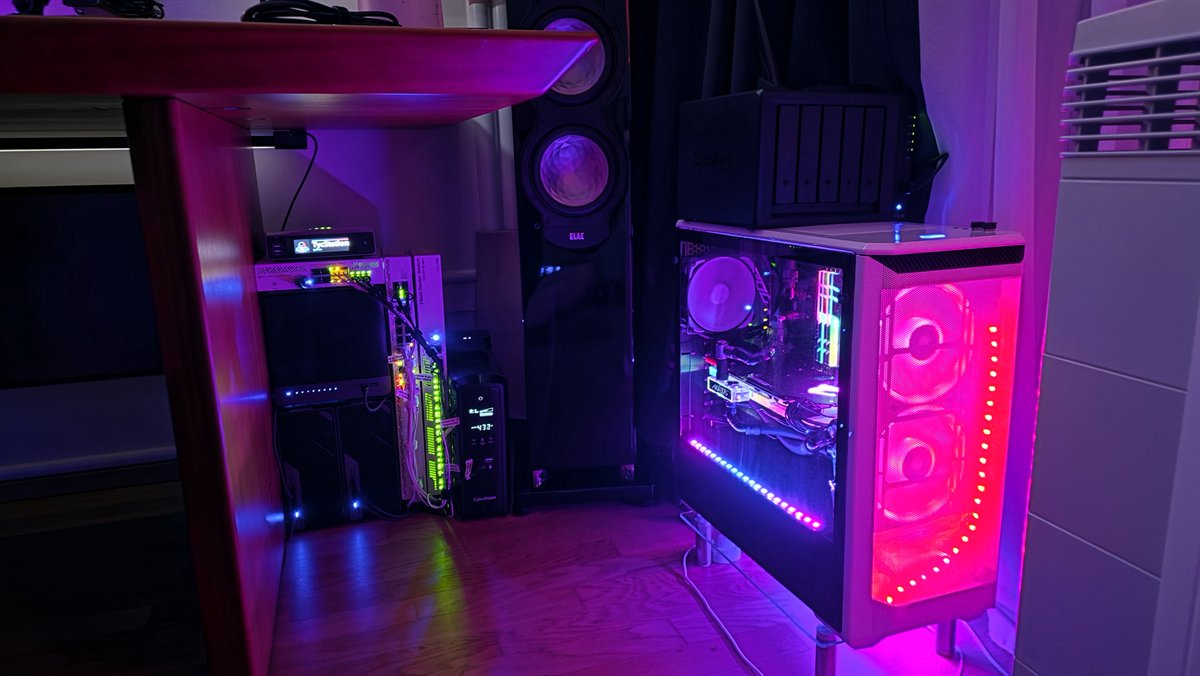
Pictures first. Four computers in a corner of a flat, what they do, and why three of them work as a team. No jargon.
Nice pictures
Just show me
Pictures first. Four computers in a corner of a flat, what they do, and why three of them work as a team. No jargon.
 Nice diagrams
Full geek-out
Zones, the firewall pair, voting, storage tiers, the change pipeline and every drill with its date. Nothing softened.
Nice diagrams
Full geek-out
Zones, the firewall pair, voting, storage tiers, the change pipeline and every drill with its date. Nothing softened.
Or skip the tour and go straight down the rabbit hole: one problem each, with the measurement that settled it.
Field notes
- Firmware for an orphaned air purifier
Two Aeris aair purifiers outlived their maker's servers. They now run an open firmware, report to Home Assistant over MQTT, and show the octopus as their fan gauge. As of 2026-09-25.
- A label on every cable
Every cable got a flag before the rack was re-plugged, printed from the same port maps that configure the switches. The label printer kept failing with a data error. Bringing its browser window to the front fixed it.
- The third vote
A container inside a network switch supplied the third vote for a two-node cluster. It took a week to build and ran for about sixteen hours. Then a third computer arrived and made it unnecessary.
- The house decides, and no clock does
The flat works out who is home and who is asleep from the door, phone and presence sensors. Getting that wrong once lit the bedroom seven times around someone who was still asleep. The automations changed accordingly.
- 45 of 132, and what the score was worth
In September an agent-run audit scored this fleet 45 of 132 possible points on an enterprise rubric of 33 criteria worth 0 to 4 each. Several of them assume a team, such as a second reviewer and an on-call rota; one person cannot pass the rubric. The audit used 72.5 million tokens across 358 runs, and the result was mixed at best. As of 2026-09-08.
- The config that deploys itself
Home Assistant pulls its configuration from git every five minutes. No deploy job reaches it.
- Four radios, and where local stops
Zigbee, Thread, Matter and Bluetooth LE connect the devices in the flat. Some run firmware built here, including two air purifiers whose maker shut down its servers. The Echo speakers still depend on Amazon.
- Backups: three copies, one restore test missing
A backup stopped for thirteen days before anyone noticed. The fleet now checks the age of its copies as well as whether they can be read. Encrypted archives sit on the third node, with another copy on the NAS; a full-fleet recovery test and an archive key outside the fleet are still missing.